
Jul 2025
The Role of Fresh, Reliable Data in Public Safety Systems
The public safety industry handles thousands of emergency calls per second, generating an immense volume of data that must be analyzed to support critical, time-sensitive decisions. However, the existing system for consolidating this data was fragmented—relying on disconnected processes that delayed access to insights and increased operational risk. To address this, we implemented a solution centered on data contracts and near real-time monitoring to dramatically reduce operational costs and response time.
The Challenge
The existing emergency response data system struggled to ensure that data flowed reliably and met service-level agreements (SLAs) around freshness, completeness, and accuracy. Data was consolidated through fragmented, disconnected processes, leading to inconsistent data quality and delays that made it difficult for decision-makers to act on timely, trusted insights.
This lack of dependable, real-time data created downstream consequences:
- Dispatch and field teams were often working with stale or partial information
- Data consumers lacked confidence in reports, requiring manual validation and slowing response
- SLAs for data availability and accuracy were frequently missed, creating friction across operations
As a result, the organization experienced higher operational costs—driven by slower response times, duplicated effort, and inefficiencies in coordination. Without a streamlined and trustworthy data flow, it became increasingly difficult to support the fast, informed decisions that public safety demands.
The Solution
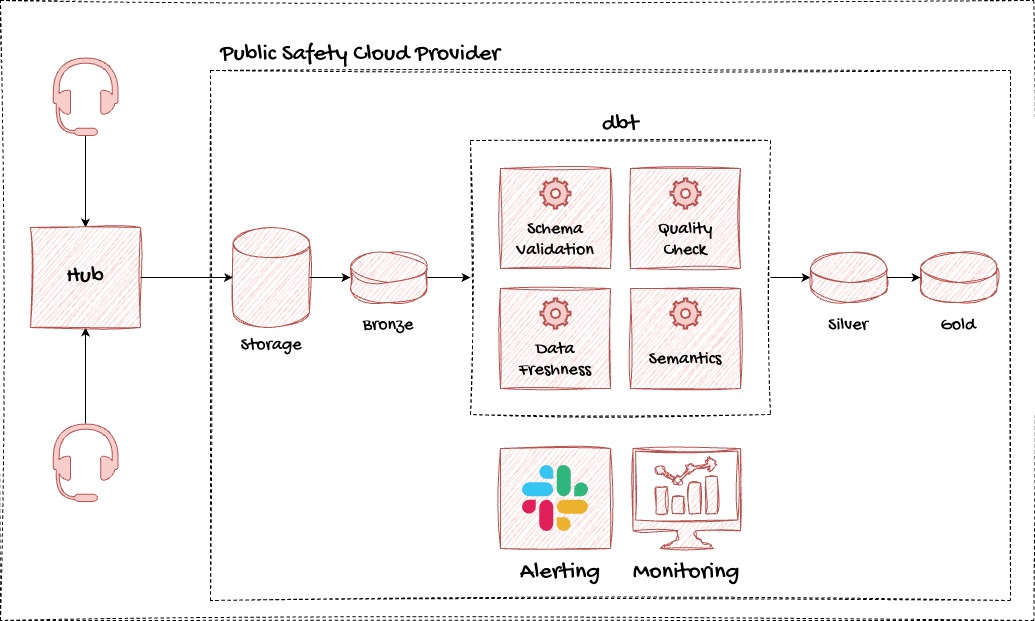
The solution addressed three critical challenges: ensuring reliable data ingestion, maintaining high data quality, and meeting service-level agreements (SLAs) for timely and accurate data delivery.
First, it enforced data contracts at the point of ingestion, validating that incoming records adhered to the expected structure, types, and standards—ensuring that only clean, trusted data entered the pipeline.
Second, it introduced real-time monitoring through alerts and dashboards, allowing teams to proactively detect and resolve anomalies, schema changes, or processing failures before they could impact downstream systems.
Finally, by automating these controls and surfacing key metrics such as data freshness, completeness, and SLA adherence, the solution provided operational teams with the visibility needed to maintain trust in the data pipeline and ensure that decision-makers always had access to fresh, curated, and actionable data.
The Impact
- Streamlined workflows reduced operational costs by ~30% since data was no longer delayed
- Improved decision-making by ensuring fresh, reliable data was always available
- Real-time alerts reduced response time ~60%
Why It Mattered
The project turned capacity planning from reactive firefighting into predictive, prioritized action. By connecting data contracts, real-time monitoring, and SLA visibility, the organization gained a trustworthy data foundation—enabling faster, more confident decisions and ensuring that public safety teams could rely on fresh, accurate data when it mattered most.